
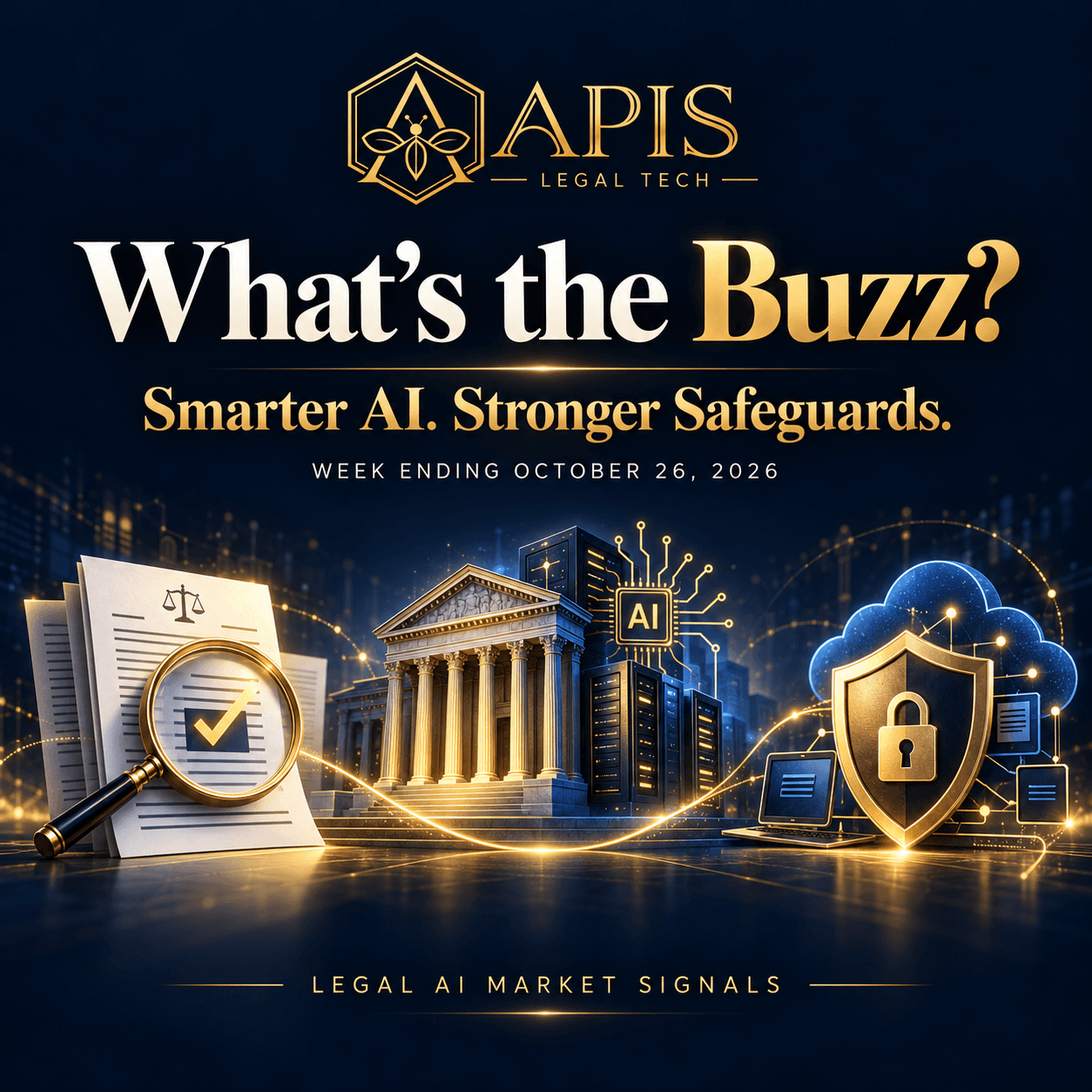
Legal AI Market Signals · Week of Oct. 26, 2026

Smarter AI. Stronger safeguards.

AI errors in court filings may be slowing, a court is building its own AI, and attackers are using AI agents. Capability is rising. So is the need to check it.

Published by Apis Legal Technologies

Legal AI Market Signals, Week of Oct. 26, 2026

Legal AI is advancing quickly. But are verification and security practices keeping pace? Three developments caught our attention this week.

1

Verification

AI hallucinations in court filings may be slowing

New research by Damien Charlotin of HEC Paris found that new instances of hallucinations and other AI-generated errors in court filings fell in the second and third quarters of 2026. Better models, more cautious users, and gaps in reporting could all explain the trend. Fewer reports do not necessarily mean fewer mistakes.

Why it matters
Encouraging news, but better AI does not eliminate the need for independent professional verification. As Charlotin warned, when a tool gets it right almost every time, people stop checking. That is exactly when the next error gets through.

2

Court infrastructure

A Louisiana appeals court invests in its own AI infrastructure

Louisiana's Fifth Circuit Court of Appeal installed two dedicated AI servers to build its own tools for court staff and judges, starting with document intake and compliance, with possible future uses in citation verification. The court is still testing commercial products, but chose not to rely on them alone.

Why it matters
Responsible AI adoption starts with workflow design and oversight, not just model selection. Courts are designing systems around how their own work actually flows. Firms can apply the same thinking at a much smaller scale: map the work first, then pick the tool.

3

Security

Microsoft reports an AI-accelerated cyberattack

Microsoft identified Storm-0940, a China-state aligned actor, using an agentic AI penetration testing framework called ARTEX to automate attacks on hundreds of organizations. Microsoft linked the group to the recently disclosed ConnectWise supply chain compromise, which gave it downstream access to customers' cloud environments, in some cases in under three hours.

Why it matters
AI security is not just about what you share with a chatbot. It is also about what connected systems are authorized to access and do. Every third-party tool with broad permissions to your files, email, or practice management system is a door someone else may try to open.

The signal underneath

The larger signal: legal AI is becoming more capable, more integrated, and more deeply embedded in professional workflows. But greater capability demands stronger verification, thoughtful system design, and appropriate security controls.

The future of legal AI is about more than adopting powerful tools. It is about implementing them responsibly, measuring their value, and keeping human judgment at the center.

What to do about it this week

  • Keep checking every citation in AI-assisted work before it is filed, even if the tool has been reliable for months.
  • Before buying or building anything, write down the one workflow you want AI to help with and who reviews the output.
  • List the third-party apps connected to your email, files, and practice management system, and remove any that no longer need access.

Not sure where your firm stands?

Our free audit walks you through where the hours are going and which tasks are worth handing to software. It takes a few minutes and you get the results immediately.